Skill atrophy: when AI makes the gesture in place of the muscle
AI speeds up the deliverables, but it can remove the gestures that build judgment. The risk does not show on the dashboard, and it hits juniors first.
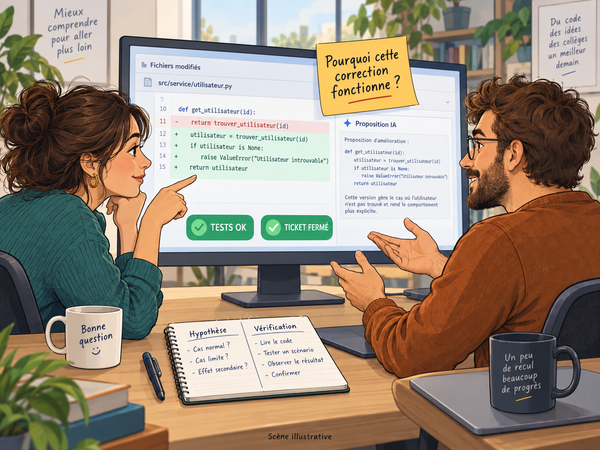
A junior developer opens a tricky ticket. Thirty seconds later, the assistant proposes a fix. He tests it, it works, he ships it.
Ask him the next day why the bug existed. He will not be able to answer. Not out of negligence: he never had to look.
The ticket is closed on time, the dashboard is green, the customer saw nothing. And yet, something did not happen.
After twenty years of observing human systems, I find that what makes a professional is not the result they deliver. It is the gesture they had to make to get there.
In medicine, an under-used muscle does not disappear overnight. It atrophies: it loses its strength, its endurance and its precision, without pain and without alarm, until the day the effort required exceeds what it can still provide.
1. Four gestures, and the one that remains
Solving a professional problem requires four gestures: diagnosing what it is about, forming a hypothesis, verifying that it holds, deciding what to do.
An assistant happily takes on the first three. The fourth remains: to validate. That is precisely the one you cannot learn alone, because it presupposes the other three.
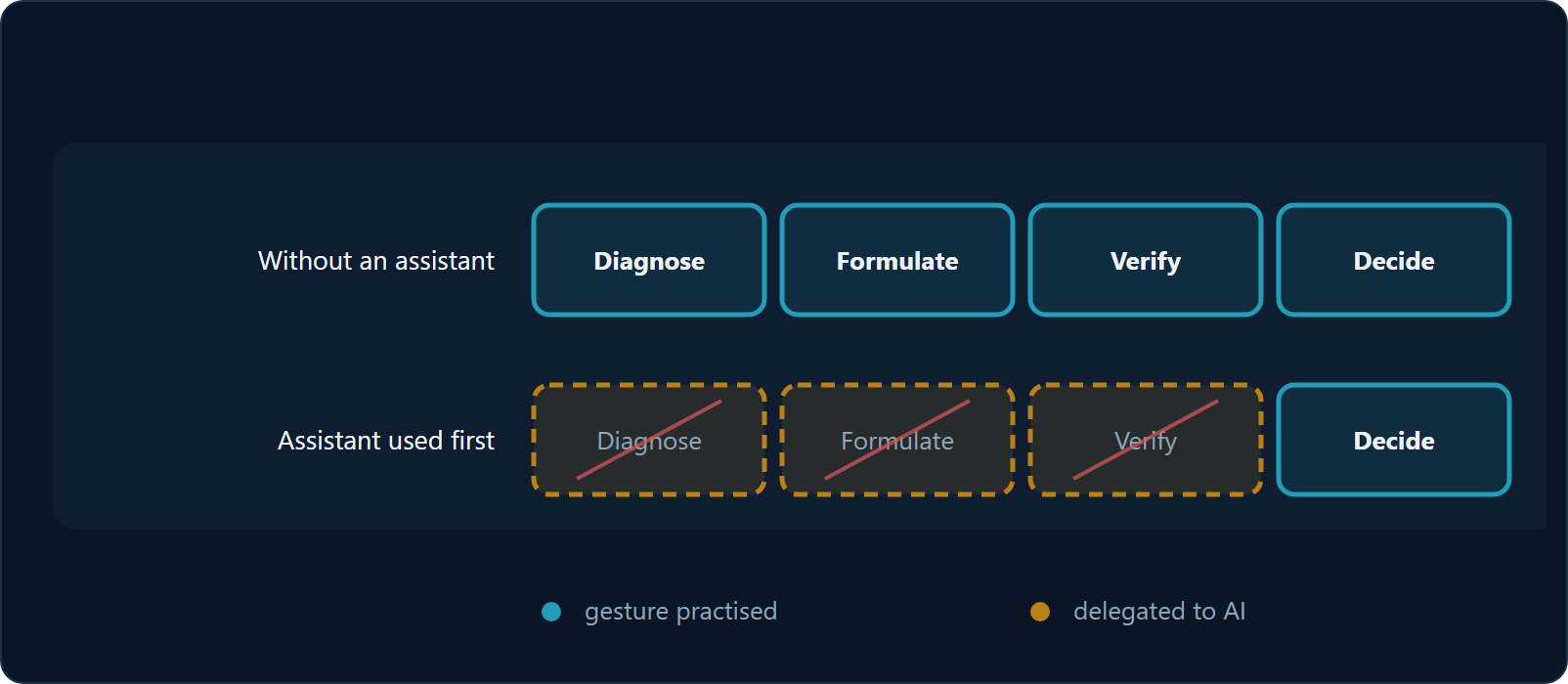
The deliverable advances, the learning does not
In Product & Discovery, a junior gets the synthesis of forty interviews without having learned to tell a revealing verbatim from an isolated opinion. In R&D, they apply a fix without understanding the mechanism of the failure.
In both cases, the work is done. In both cases, the skill that was meant to build did not build.
2. It is not the tool, it is the timing
The problem is not using AI. It is using it before having tried.
After a first attempt, the assistant is an excellent partner: it corrects, it contradicts, it opens a path you had not seen. Before any attempt, it removes the repetition that learning needs.
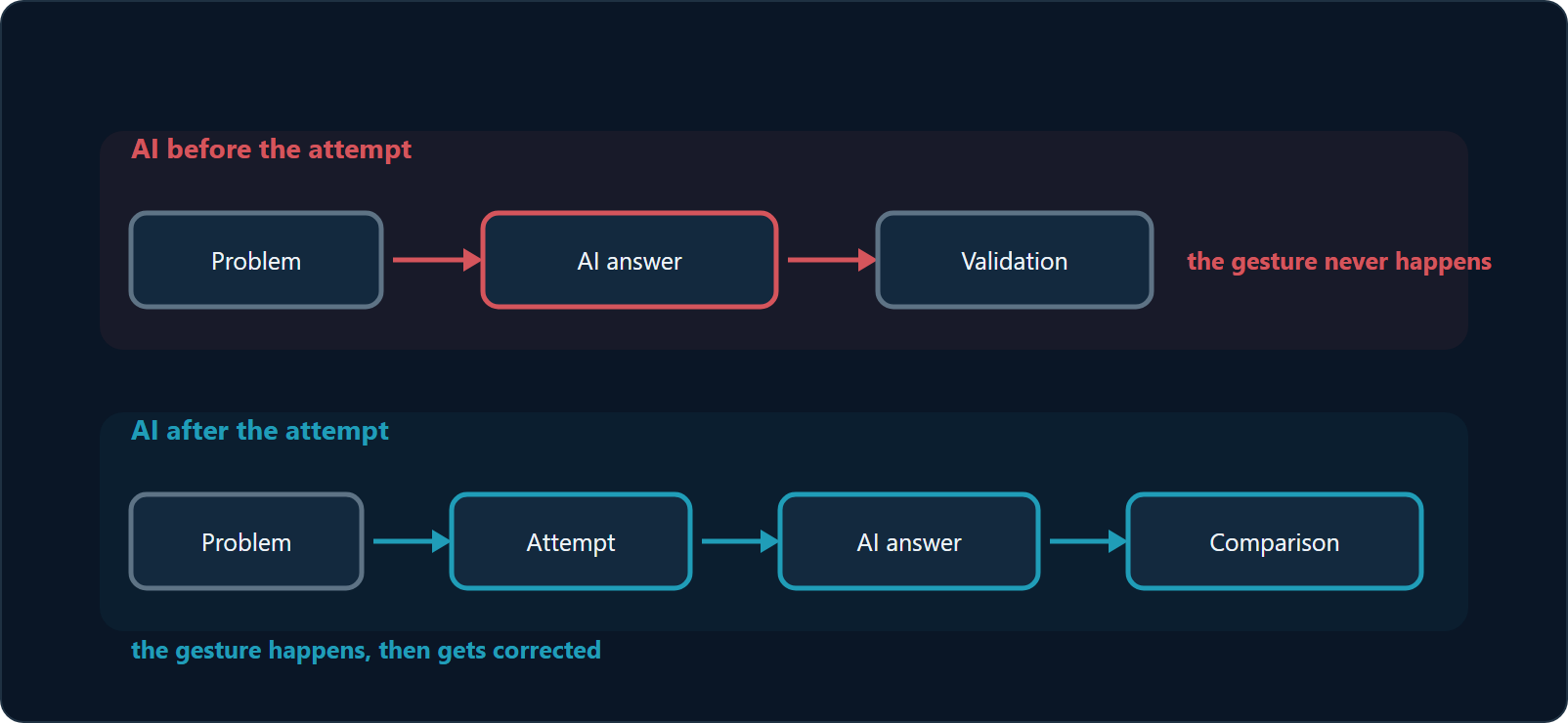
Nobody measures that moment
Teams track production time, ticket count, velocity. None counts the occasions where someone had to reason alone before getting an answer. Yet that is the only thing that keeps the muscle in shape.
3. What the research says, and what it does not
A study by Microsoft Research and Carnegie Mellon, presented at CHI 2025, covered 319 knowledge workers and 936 professional uses of AI. It observes an association between a higher declared trust in the tool and a lower declared mobilisation of critical thinking.
An essential caveat: these are declarations, not measurements, and an association, not a causation. The study does not prove that AI destroys skills, and it follows no one over time.
What it does is point to where to look: the occasions for practice that an organisation removes or preserves, without ever deciding so explicitly.
4. Juniors are not slower seniors
A senior has landmarks built before these tools. When the assistant proposes an answer, they compare it, often without thinking, to dozens of situations already encountered. They exercise their judgment even when they accept the proposal.
A junior does not have that stock. Asking them to validate an answer they could not have produced is asking them to assess work with a muscle they do not yet have.
The conclusion is not to reserve AI for experts
It is to distinguish two families of tasks:
- production tasks, where speed is the goal, and where the assistant should come in early;
- formative tasks, where the effort of reasoning is part of the expected result, and where it should come in after.
This distinction is decided. Otherwise, it is suffered.
5. The rehabilitation: three simple gestures
The attempt first
On formative tasks, require a written hypothesis, even short, even wrong, before any recourse to the assistant. It is the contraction before the load.
The justification after
Once the answer is obtained, ask what was kept, changed, rejected, and why. The tool becomes a rehabilitation partner rather than a substitute.
The rotation of the conclusion
In team review, rotate the person who has to defend the final decision. Judgment is kept in shape out loud, not in silence.
The prescription
Ask your teams a simple question: on which tasks do you get a result faster than before, with less independent thinking?
The answers will not be the same by seniority, and that is exactly the useful information. A senior will tell you they saved time. A junior will tell you, if they feel safe enough to say it, that they no longer quite know why it works.
That is the gap we ended up building into a tool. CheckupIT can be one of the solutions, on two levels.
The first level, the organisation
The shared questionnaire, twelve minutes, given to managers and operational staff. In "Analyses Avancées", Comparaison par Population separates leadership, managers, operational staff and new joiners: compare that last column to experienced operational staff on the People axis. A marked gap says the two populations no longer live the same job.
The second level, the team campaign
This is where the subject of this article becomes measurable. Launch a campaign scoped to the development team: it adds a set of questions specific to its craft, on its actual practices, code quality, review, dependencies, delivery metrics. Atrophy reads there, in the practice, not in an engagement dashboard.
In both cases, three respondents minimum per level, otherwise the reading stays blurred. It is not a setting: it is what lets a junior answer frankly.
Then put it to work
Cross the two levels. A strong gap between juniors and seniors, combined with a low score on code review, points to exactly the practice where the assistant makes the gesture in place of the muscle. Treat that practice, one single rule, for example a written hypothesis before any recourse to the assistant on formative tasks, then run the campaign again next quarter.
An honest caveat: the org questionnaire does not probe your AI usage. It is the team campaign that reaches the practices; the organisation, for its part, measures the gap between those who are learning and those who already know.
Atrophy never reads on a dashboard: the deliverables ship, the deadlines hold. It is discovered the day you have to solve what the assistant does not know how to do.
And that examination takes twelve minutes per person.