The Annual Engagement Survey: One X-Ray a Year for a Chronic Disease
Every year, the same ritual: six weeks of design, three weeks of collection, six weeks of analysis. By the time the engagement survey results reach the boardroom, they describe a company that no longer exists. The problem isn't your thermometer. It's the frequency of the exam.

The ritual never changes. In spring, six weeks of negotiation over question wording. In autumn, three weeks of collection and reminder emails. Then six weeks of analysis at the vendor's. And in January, the readout: seventy slides, one global score, three "areas for improvement".
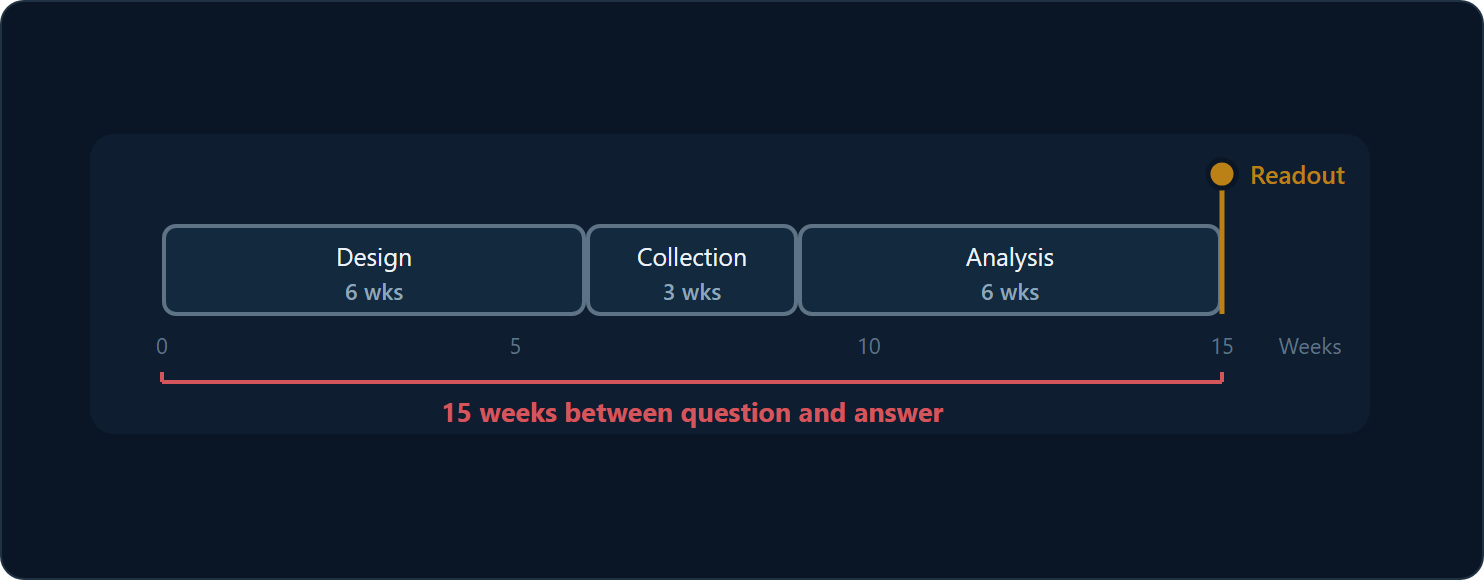
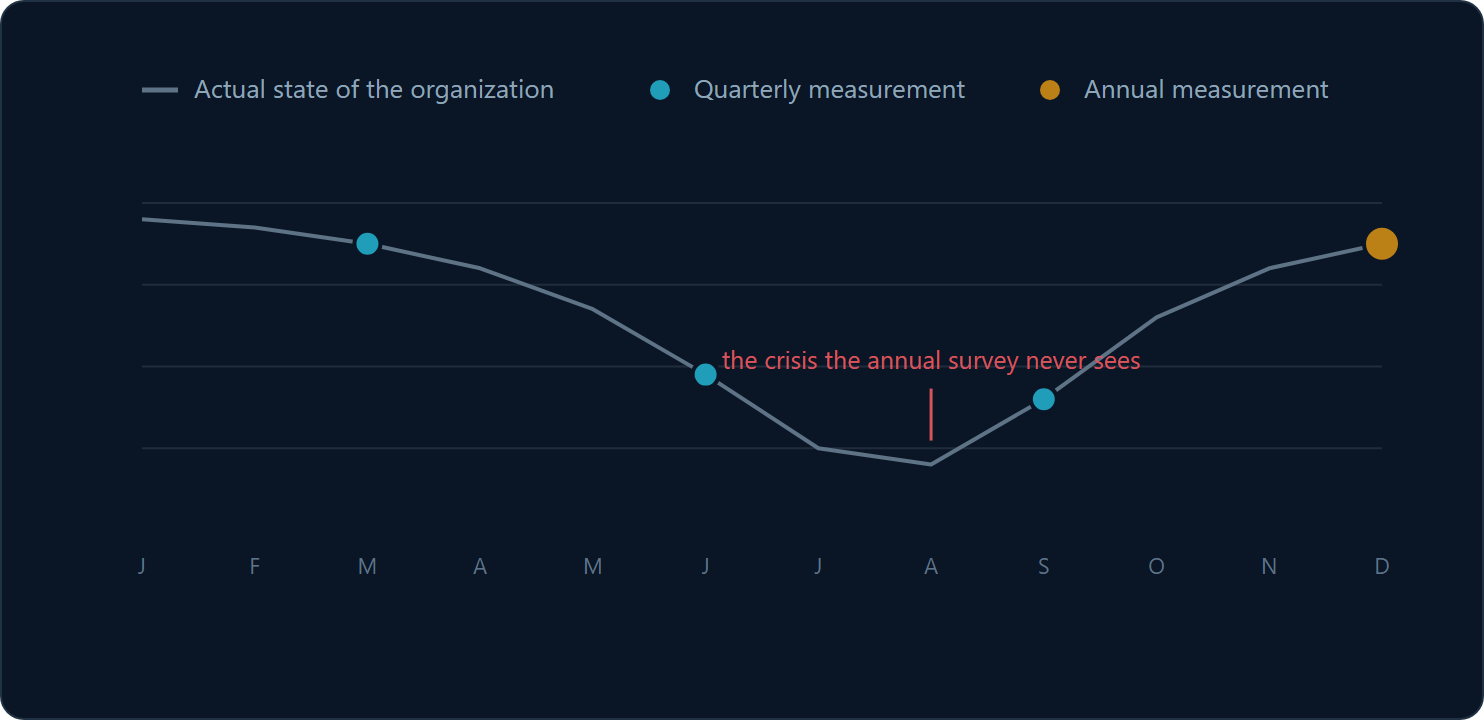
By the time those results land on the table, the struggling team has already lost its two best people. The project that crystallized the tension has shipped, or been cancelled. You are not reading a diagnosis. You are reading archives.
The usual critique of the survey is that it is a "bad thermometer". After twenty years of observing human systems, I believe this critique misses the point. The thermometer is fine.
The problem runs deeper: you are prescribing an annual exam for a chronic disease.
1. Acute or chronic: the prescription error
For an acute condition, a fracture, a one-off exam is enough: photograph, treat, verify.
For a chronic condition, diabetes, the photograph is nearly useless. What matters is the trajectory. Nobody manages diabetes with one blood test a year.
Organizational dysfunctions are chronic conditions. Disengagement, silos, overload: they settle in slowly, evolve in flare-ups, respond with delay. Gallup measures around 7% of "engaged" employees in France, year after year. That stability is the very definition of a chronic state.
2. The three iatrogenic effects
A wrongly prescribed exam is not merely useless. When the care device worsens the patient's condition, medicine calls it iatrogenic. The annual survey has three such effects.
"They asked for our opinion and nothing changed."
The most destructive one. Soliciting people's voice creates an expectation; a disappointed expectation costs more than silence. Every campaign without a visible action plan teaches that answering is pointless.
The anaesthetic average
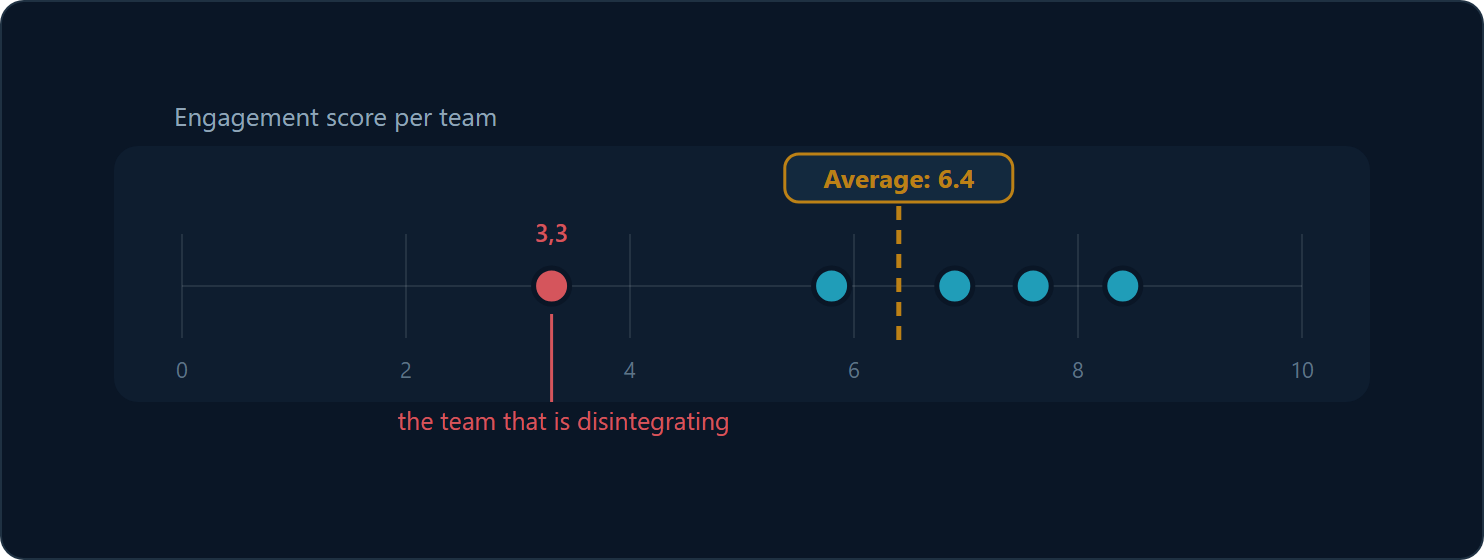
A global score of 6.4 aggregates the team that is thriving with the one that is disintegrating. It produces a lukewarm number that demands no decision. No doctor treats a hospital's average temperature.
The theatre of measurement
Annual, solemn, public, the exam becomes a stake in itself. Teams get "prepared", the favourable quarter gets picked. The organization learns to pass its exam, not to get better.
3. What monitoring a chronic disease requires
A frequency matched to the pathology's rhythm
Not the weekly "pulse", which exhausts as much as the annual ritual. The right frequency lets you measure, act, re-measure. A quarter is often the right tempo; a year never is.
The granularity of the organ
A reading per team, per axis, where someone can act. With one safeguard: anonymity by construction, no aggregate below three respondents.
The comparison of readings
The blind spot of almost every survey: it never superimposes the field's image on what leadership believes. A leadership that rates an axis at 7.5 while the field lives it at 4.6 does not have a climate problem: it has a blind spot.
4. "More questionnaires?"
The objection is legitimate. But the fatigue does not come from frequency: it comes from the ratio between effort asked and effect obtained.
Twelve targeted minutes, followed by a visible action plan within a fortnight, weary people less than forty-five annual minutes with no tomorrow. What your teams reject is not giving their opinion. It is giving it for nothing.
The prescription
Don't throw away your thermometer: change your monitoring regime.
- short, frequent measurements rather than an annual exam;
- a per-organ reading rather than an organism-wide average;
- anonymity by construction, never by promise;
- the systematic comparison of leadership and field readings.
This is the regime we ended up building into a tool. CheckupIT can be one of the solutions, because it offers exactly that: a twelve-minute measure that campaigns can relaunch, a per-team and per-axis reading, anonymity by construction (no aggregate below three respondents), a score history to read the trajectory, and the leadership/field comparison.
A chronic condition is not cured in one campaign. But it can be managed. The first reading takes twelve minutes.