Stop Trying to "Break Down Silos": Your Organization Has Sclerosis
"We need to break down the silos." If silos could be broken with a sledgehammer, there wouldn't be a single one left. The problem: the metaphor is wrong, and it prescribes the wrong remedies.
"We need to break down the silos." Say that sentence in a meeting and watch: everyone nods. It appears in the CEO's January address, in the consulting firm's slides, in the announcement of the umpteenth reorganization.
It is the most consensual sentence in modern management. That should worry you: if silos could be broken by proclaimed willpower, there would not be a single one left.
The metaphor leads us astray. A silo is a wall: you erect it, so you can tear it down. Hence the demolition-shaped remedies. After twenty years of observing human systems, I watch them fail with metronomic regularity.
What your organization suffers from is not a matter of walls. It is sclerosis: a progressive hardening of the tissue that connects the organs.
1. Your organs are fine. It's the tissue that is hardening.
Specialization is not the disease. A body needs differentiated organs; your organization needs a marketing that thinks market, a tech that thinks system. The "silos" people want to break are healthy organs.
The pathology lies in the connective tissue: what circulates between the organs. Information, requests, feedback, trust.
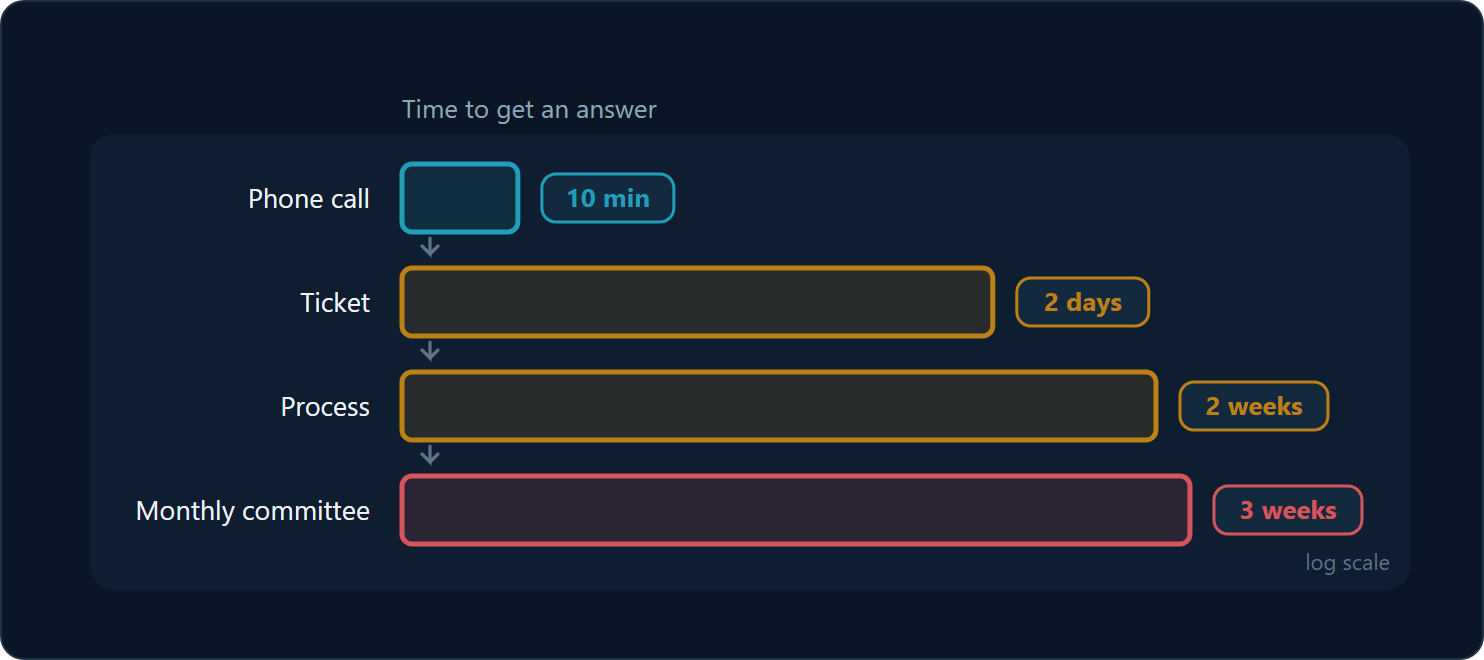
At first, this tissue is supple. A developer calls the salesperson: ten minutes, solved. Then the phone call becomes a ticket, the ticket a process, the process a monthly committee. Each notch is reasonable. The accumulation is not.
The symptoms, you know them:
- the customer who receives two contradictory answers from two departments;
- the duplicated work discovered by accident ("wait, you're building that too?");
- and this sentence, heard in every diagnostic: "we learn what the next team is doing from LinkedIn".
2. Where the hardening comes from
The objectives
A signature target for sales, a margin target for production: the conflict is prescribed. Every organ hits its targets, the organism sinks.
Conway's law
Since 1968: your products copy your communication structure. Teams that don't talk to each other produce parts that don't talk to each other. Show me your product inconsistencies and I will draw you your real org chart.
Distance
Stanley McChrystal documented it in Team of Teams: the less you interact, the more the other becomes a caricature ("tech always says no"). And the more the caricature justifies not interacting.
3. Why the sledgehammer breaks nothing
The reorganization
relocates the borders of the hardening. Eighteen months later, the sclerosis has reformed along the new lines.
The collaboration tool
confuses the channel with the circulation. A hardened tissue with a better pipe produces noise that travels fast, not trust.
The team-building offsite
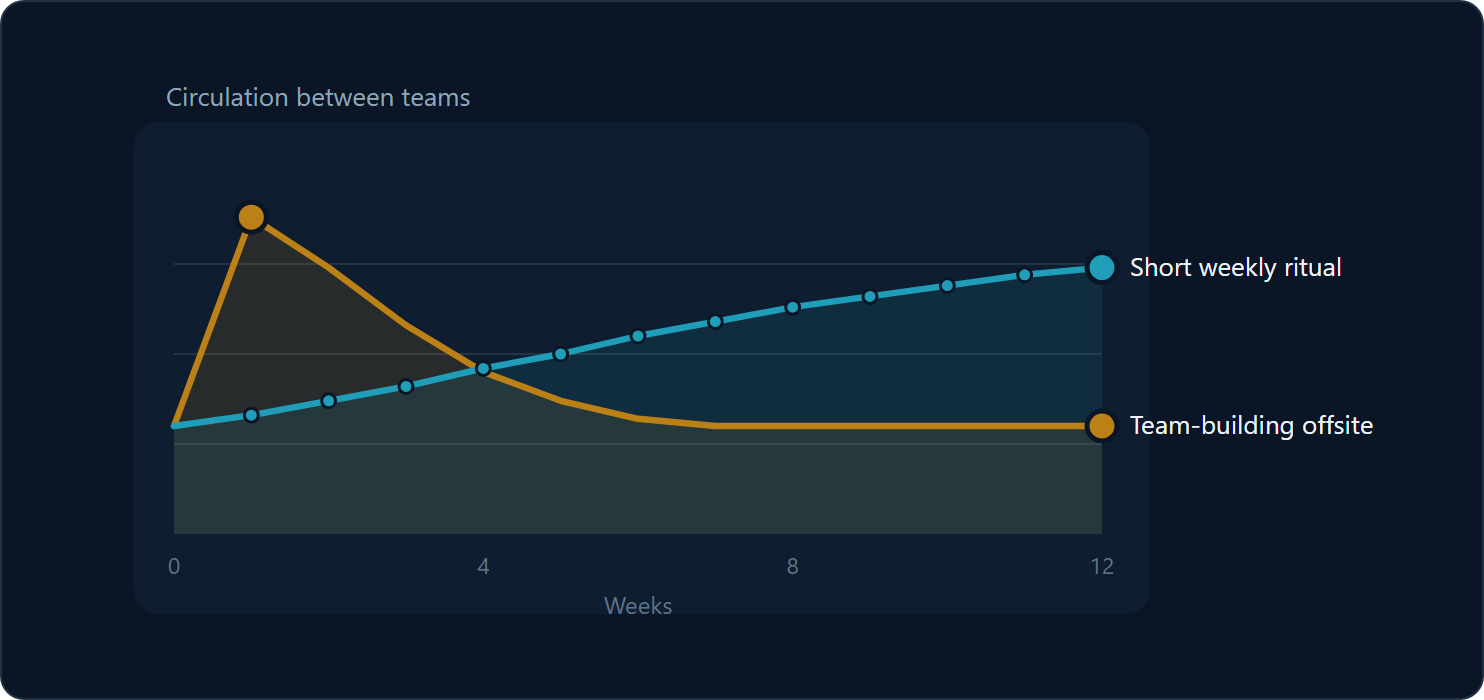
is a short-acting vasodilator: a few weeks of improvement, then the tissue returns to its rigidity. Nothing changed in what produces it.
4. The treatment: retraining the circulation
Sclerosis cannot be broken; it must be retrained. Four moves.
Measure the real circulation, not the org chart
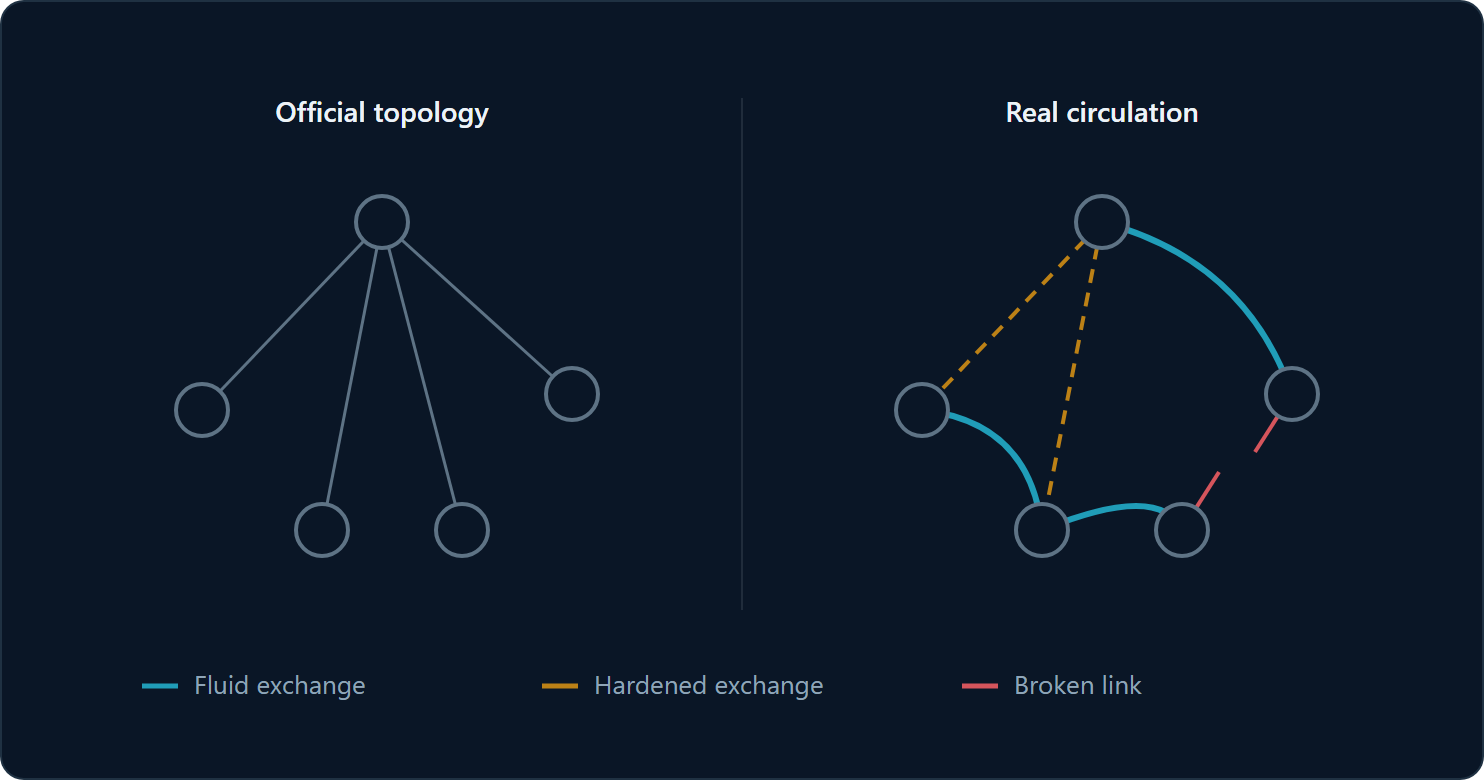
Who actually works with whom, where the exchange flows, where it grinds. The gap with the official structure is your X-ray.
Align the incentives
At least one major objective shared by organs that must cooperate. As long as each is paid to optimize alone, no offsite will change anything.
Make the interfaces explicit
Who asks what of whom, in what form, within what delay. The implicit is exactly where sclerosis lodges itself.
Install short, regular rituals
Fifteen weekly minutes between organs that depend on each other. Suppleness is maintained by frequent movement, not by violent, occasional stretching.
The prescription
Stop promising to break what is not a wall. Diagnose first: which organs no longer communicate, on which axes, with what gap between what leadership believes and what the field lives. Then treat the tissue: incentives, interfaces, rituals.
This is the X-ray we ended up building into a tool. CheckupIT can be one of the solutions, on two levels.
The first level, the organisation
The shared questionnaire, twelve minutes, anonymous by construction (no aggregate below three respondents). It gives the leadership/field gap per axis: where circulation is felt as fluid at the top and painful at the bottom.
The second level, the topology
This is the heart of the matter, because sclerosis is not in the organs but in the tissue between them. The map of interactions and the tension matrix between teams measure exactly that tissue: who actually works with whom, where the exchange flows, where it hardens, where the link is broken. You no longer read the official org chart, you read the real circulation, and the gap between the two is your X-ray.
That is where the order of treatment is decided: the most tense interface is the one to make explicit first, before incentives and rituals.
The initial mapping requires neither a reorg nor an offsite. Twelve minutes per person is enough.