The Neighbor's Prescription: Adopting AI Because Others Do Is Medical Malpractice
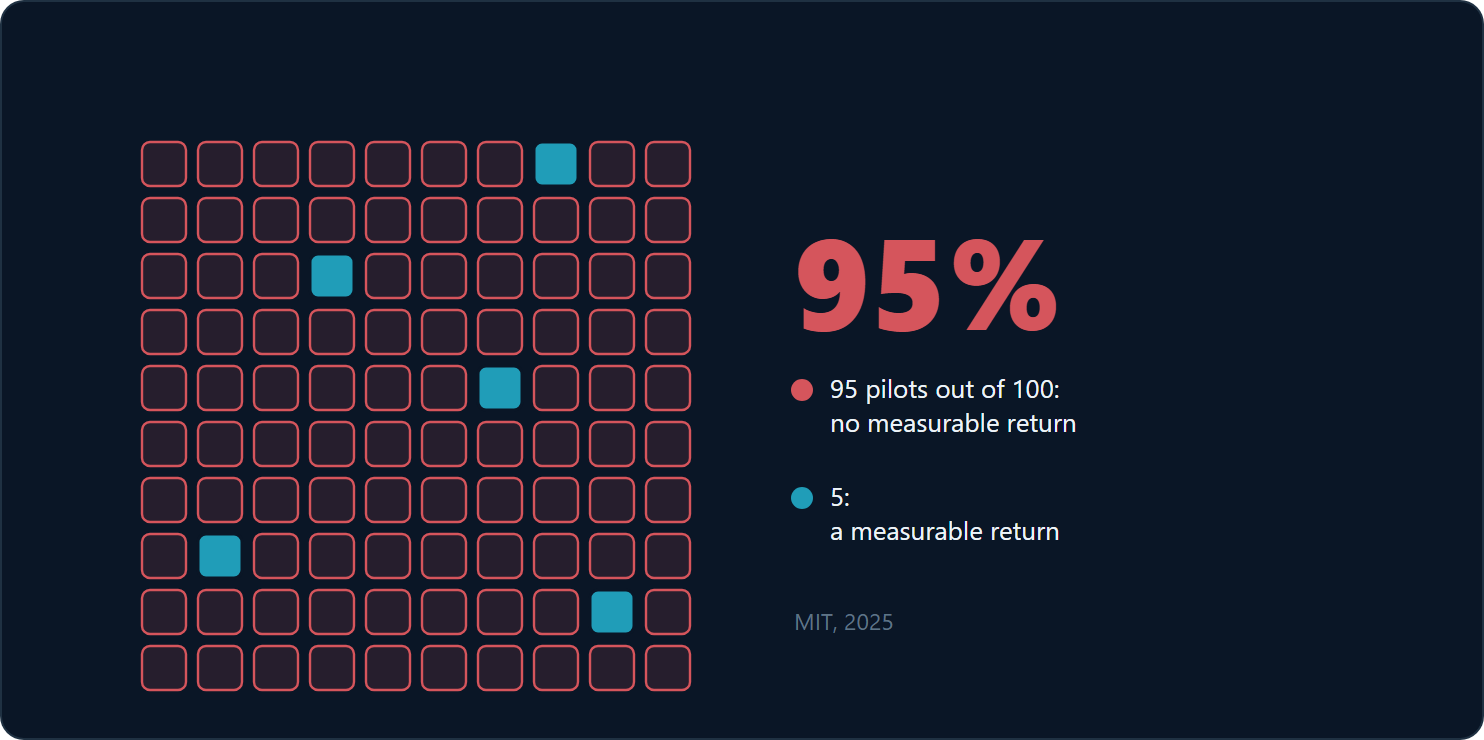
"My dev team must do AI. My US counterpart is already doing it." A CTO actually said this. In medicine, taking your neighbor's treatment without an exam has a name: self-medication by imitation. It works the same in business, and it fails 95 times out of 100.

A few weeks ago, a CTO called a sales rep at a company I work with. His request fit in one sentence: "My dev team must do AI. My US counterpart is already doing it." No problem to solve, no use case, no measure.
You have heard this sentence. Perhaps you have said it. It circulates in every executive committee: "the board is asking where we stand on AI", "our competitors are communicating about it", "we can't do nothing".
And it produces remarkably consistent results.
We call this "being late", "catching the train". The race metaphor suggests you only need to accelerate. After twenty years of observing human systems, I believe it describes everything except what is happening.
What this CTO is doing has a name in medicine: the neighbor's prescription. Taking someone else's treatment, prescribed for another organism, because he seems to be doing better than you. It is the most elementary mistake of self-medication.
1. A treatment is not a goal
"Doing AI" is not a goal, any more than "taking antibiotics" is a health plan. A treatment is prescribed for an indication: an identified problem, in an examined patient, with a measurable outcome.
AI has a property that tool vendors rarely mention: it amplifies what exists.
Applied to a healthy process, with code reviews and reliable tests, it accelerates value. Applied to a sick process, it accelerates the sickness. Code generated faster in a codebase without tests produces debt faster.
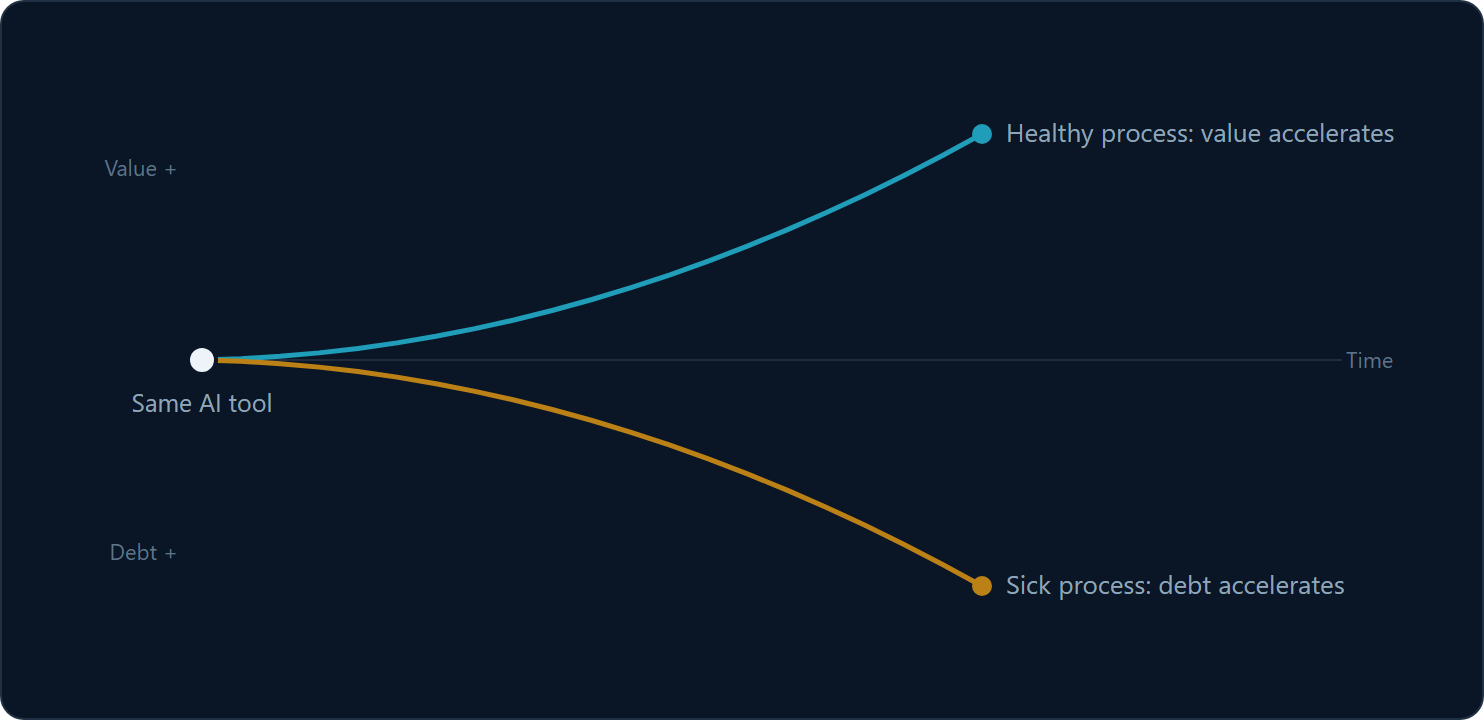
Computer scientists have had an adage for this for sixty years: garbage in, garbage out. AI does not escape it. It adds speed.
This is why the MIT figure should surprise no one. Those 95% do not measure the weakness of the technology. They measure the absence of diagnosis before the prescription.
2. What imitation prevents you from seeing
The executive who imitates does not ask "what problem do we have that AI could treat?". He asks "how do we do AI?". When the goal is "doing some", every deployment is a success and none produces value.
Imitation also hides a reality: your teams are already doing it. The phenomenon is called shadow AI. Developers using code assistants without telling anyone. Project managers writing their reports with a consumer chatbot.
While the executive committee debates "getting started", the organism is already consuming it. Without dosage, without monitoring. The real starting point is not zero. It is: actual usage unknown, actual risks unknown.
3. The protocol: diagnose before prescribing
Faced with this CTO, the easy answer was to sell licenses. The right answer was an examination. Four steps, in order.
The maturity audit
Who already uses what, how often, with what critical distance. And the appetite: who wants to grow, who is worried.
The workshops
Surface the use cases from the ground up. A use case a team formulated itself does not need to be sold to them.
Individual interviews and anonymous measurement
The workshop has a limit, documented since Noelle-Neumann: the spiral of silence. When the majority gets enthusiastic, the skeptics go quiet. Yet their reservations are the most valuable information. The silent contradictor, ignored, becomes eighteen months of passive resistance.
The impact map
An "AI for devs" project does not concern only the devs: Product specifies differently, HR revisits the skills, support inherits what was shipped faster. Prescribing to one organ without examining its interactions is an ignored contraindication.
4. The right dosage
Medicine has one last concept to offer: titration. You do not prescribe the maximum dose on day one. You start low, measure the response, adjust.
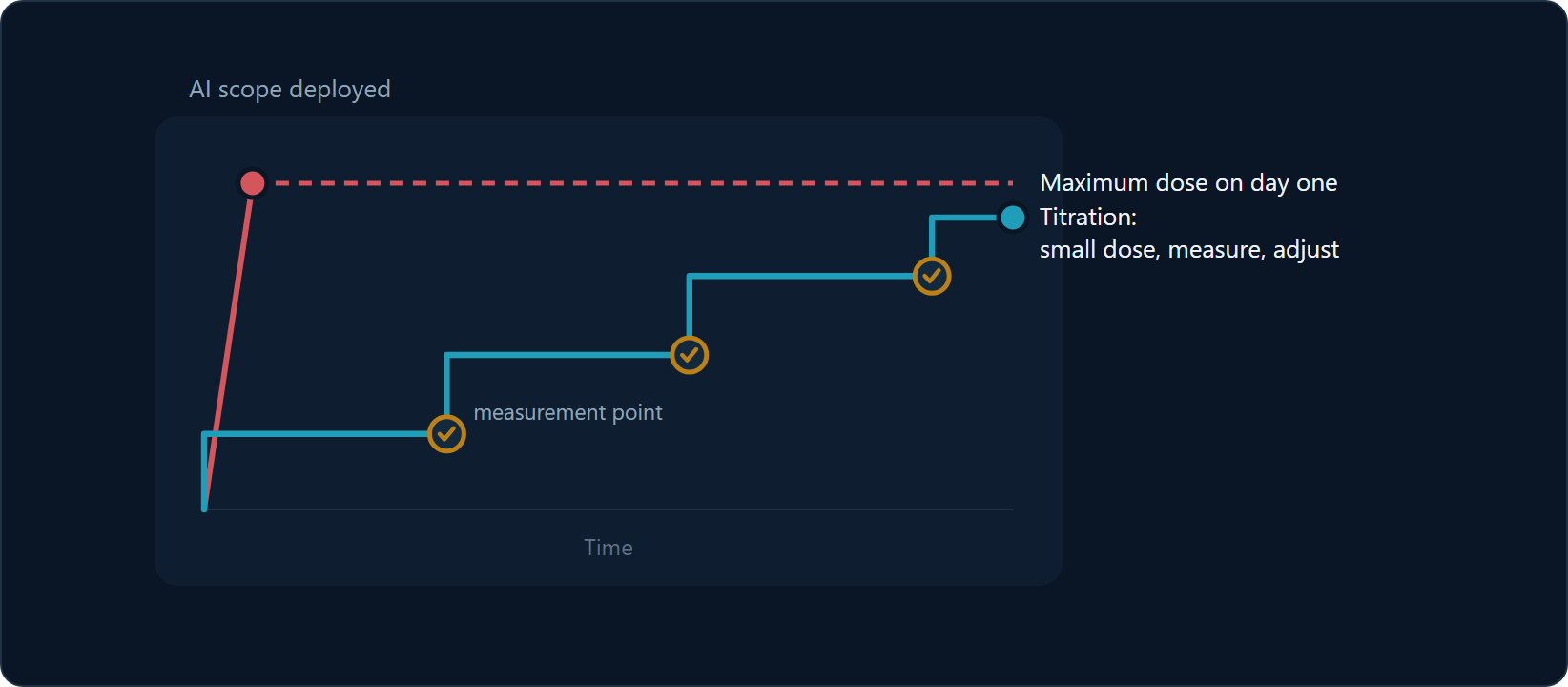
For AI: a pilot scope chosen for a measured pain, indicators defined before deployment, a measurement point at a fixed date, then extend, adjust or stop.
And an assumed success criterion: boring metrics. Cycle time going down, tickets decreasing. Successful AI projects become invisible.
The prescription
If your counterpart is doing better than you, the right question is not "what medicine is he taking?". It is: what is my organism suffering from, and is this treatment indicated for me?
- audit your teams' actual maturity and appetite;
- surface the use cases in workshops;
- listen to the skeptics individually and under anonymity;
- map the impact across the whole chain;
- then titrate.
This is the examination we ended up building a tool for. CheckupIT can be one of the solutions, because it offers exactly what imitation lacks: a measurement that is anonymous by construction (no aggregate below three respondents), where the skeptics can say what they think at no cost, with a reading per team and per hierarchy level.
It all starts with an examination. And it takes twelve minutes per person.