Organizational Diplopia: Why Your Leadership and Your Field Teams Don't Describe the Same Company
Ask your executive committee to rate the company's health, then ask your teams the exact same question. The two scores never describe the same organization. It's not a communication problem: it's organizational diplopia, and it can be treated.
You know that start-of-year meeting. The CEO walks through the year: excellent numbers, curves that keep climbing, customers renewing, an internal satisfaction score on the rise. The slides look good, nobody objects.
Two rows back, someone from the field leans towards their neighbour and whispers: "does he actually work here?"
Because from where they sit, the same year looks like something else. The curves are climbing, but their team lost two people nobody replaced. Customers are renewing, but they spend their Friday evenings catching up on deliveries promised too fast. Internal satisfaction is up, and they remember filling in that survey in three minutes, on a Tuesday, between two meetings.
Neither of them is lying. Both are looking at the same company. That is exactly where the problem starts.
So try the experiment. Ask your executive committee to rate the health of the organization out of 10, anonymously. Then ask the same question, in the same words, to your operational teams.
I have run this exercise for years. The result is disturbingly consistent: leadership sees an organization at 7. The field lives in one at 5.
We call this a "disconnect", an "ivory tower". The assumed remedy: communicate more. After twenty years of observing human systems, I am convinced this diagnosis is wrong.
What your organization suffers from has another name in medicine: diplopia. Double vision. Two images of the same object that no longer fuse.
1. Two sharp images, no fusion
Diplopia is not a disease of the eye. In most cases, each eye works perfectly: it is the fusion of the two images by the brain that fails.
Leadership's image is built from reports, consolidated KPIs, prepared presentations. The field's, from daily experience. Both are sharp, coherent, convincing. They are simply different.
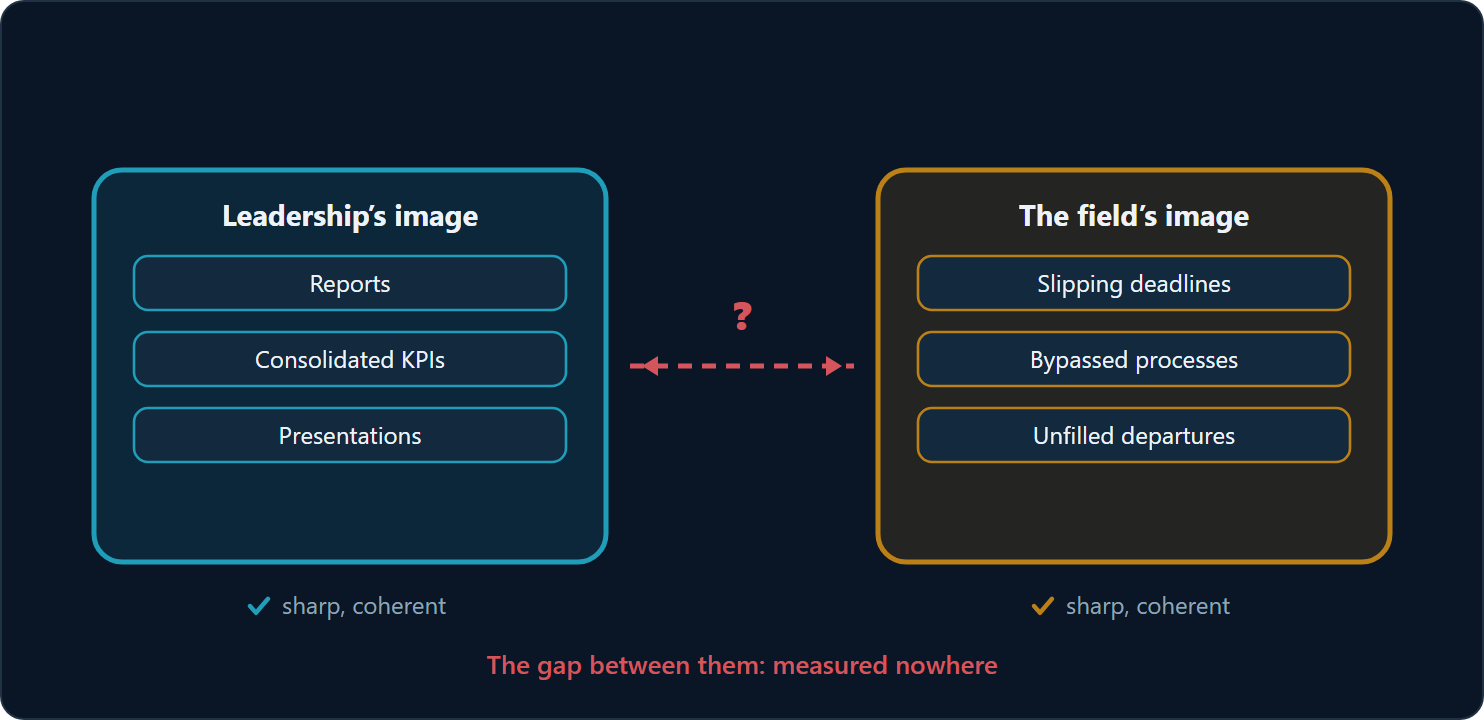
Neither image is false. That is the trap: everyone is right from where they stand, and everyone can produce evidence.
And the organism eventually does what the brain does: it suppresses one of the two images. Guess which one. The one that doesn't sit on the executive committee.
2. The origin of the disease: the upward filter
Why do the two images diverge? Because information travels up filtered. Researchers call it the mum effect: each level removes a little gravity from the bad news.
The bug becomes "a point of attention". The failing project, "a project under pressure". The exhausted team, "a highly committed team". Nobody lies: everyone is polite, careful, attentive to what the level above wants to hear.
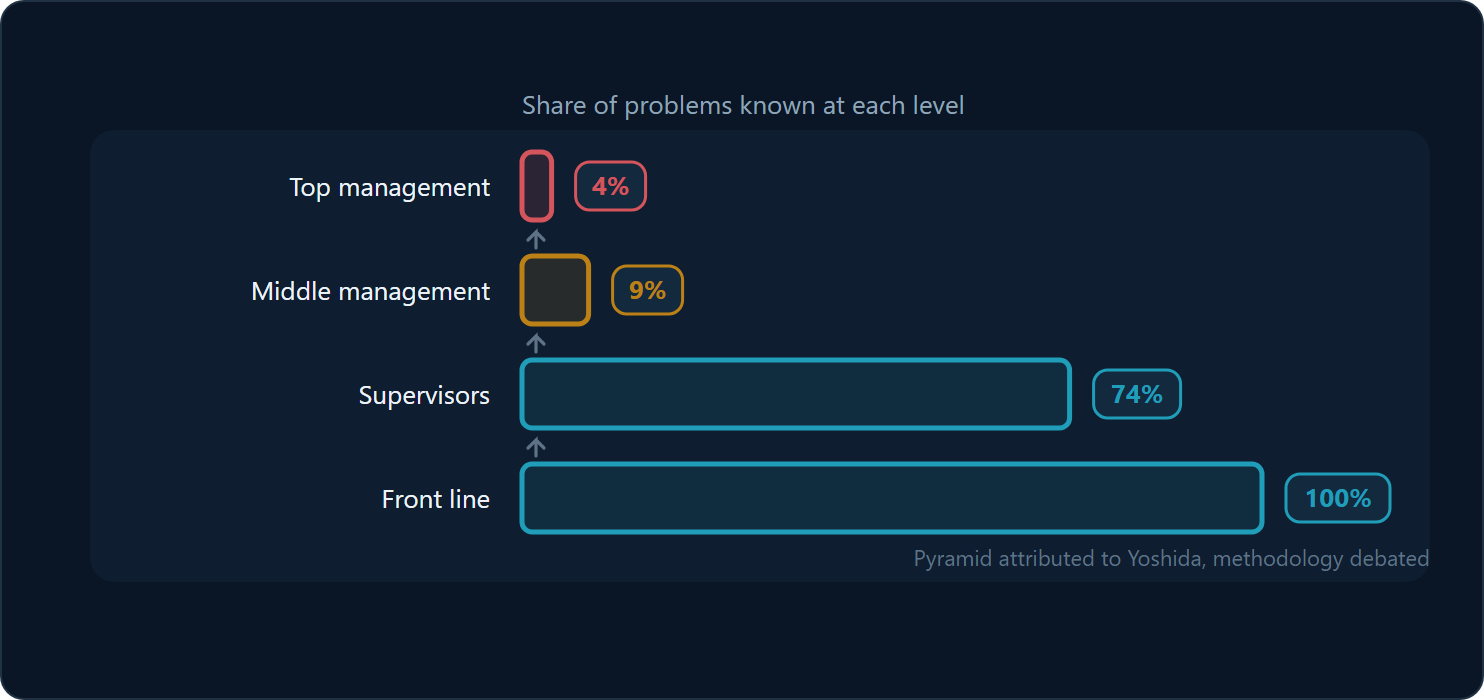
Three amplifiers worsen the filter:
- hierarchical distance: four levels, four compounded filters;
- surviving metrics: the delivery rate travels up, the team's fatigue does not;
- confirmation bias: a leadership that announced a strategy looks for the signals confirming it.
3. Why your current remedies fail
The annual survey
measures a single image, the field's, once a year. You get an engagement score; you do not get the gap.
Skip-levels and open doors
reproduce the very filter they claim to bypass. Alone, not anonymous, facing an executive, you tell a polite version of the truth.
Management by dashboards
A green report proves one thing: the chosen indicators are green. Nothing else.
4. The treatment: measure the gap, not the score
You do not treat diplopia by improving one eye: you retrain the fusion. Three principles.
The same questions at every level
Leadership, managers, operational staff. That is the condition for the two images to be comparable.
Anonymity by construction
No individual readings, aggregates from three respondents up. Frankness cannot be decreed; its cost can be removed.
The gap as the indicator
A climate at 6.4 says nothing. The information is that leadership rates engagement at 7.5 while the field lives it at 4.6. That 2.9-point gap is your blind spot: the place where you decide based on an image the other half of the body knows to be false.
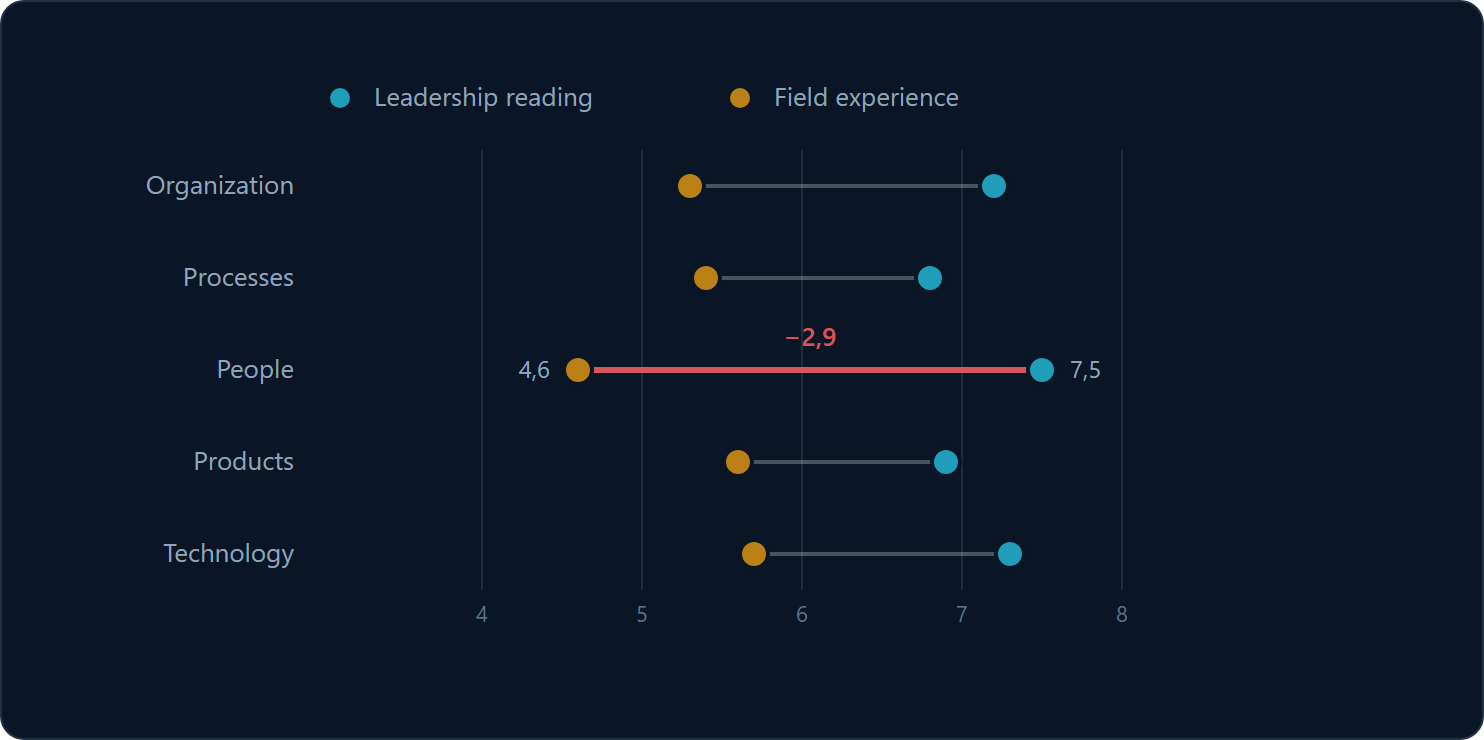
Two fused images give you depth. A leadership team that only sees its own lives in a flat world.
The prescription
No team-building seminar, no extra internal newsletter. A simple protocol:
- the same questions at every level;
- structural anonymity;
- the gap measured, axis by axis;
- a cross-reading at a regular cadence.
This is the protocol we ended up building into a tool. CheckupIT can be one of the solutions, because it offers exactly these four guarantees: the same questions asked at every level, anonymity by construction (no aggregate below three respondents), the leadership/field gap computed axis by axis, and the axis with the largest gap flagged as the blind spot.
The good news: unlike the ocular version, this one can be diagnosed in twelve minutes.