The Empty Shell Syndrome: Structural Obesity vs. Anorexia
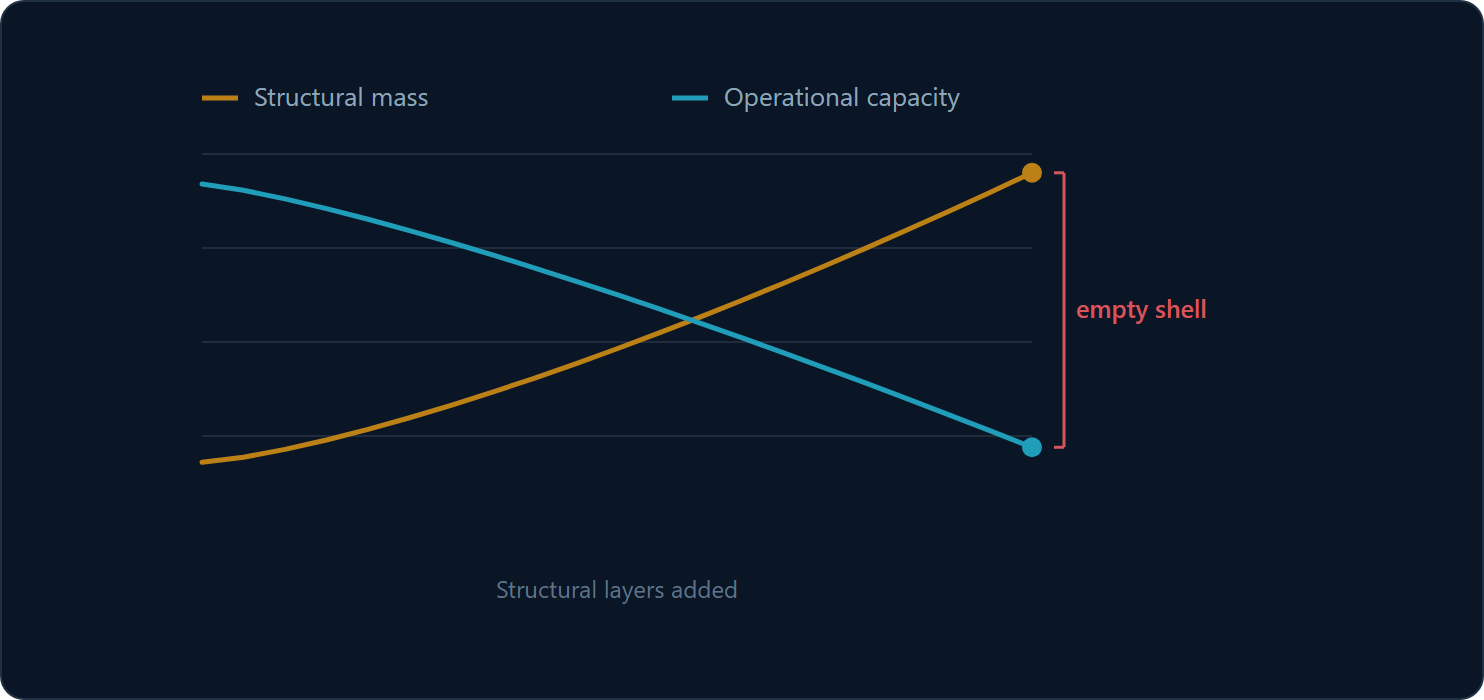
A 90-page report does not make an organization. Structural obesity plus operational anorexia yields an empty shell: many boxes, no energy to produce. Here is how to treat it.

The document landed on the desk with a heavy, almost threatening thud. 90 pages. Glossy paper, thermal binding, a "Big Four" consulting logo watermarked on every page. The title, in all caps, commanded respect: "Low Level Design (LLD), Target Operating Model."
It’s beautiful, it’s dense, and it’s incredibly reassuring for an Executive Committee that just signed a six-figure check. It is a powerful managerial sedative. But upon opening it, provided you’ve actually spent time in the trenches of a real transformation, you quickly spot the "empty shell" syndrome.
You’ve bought a magnificent blueprint for a building where no one knows which door to enter, where the light switches are, or who takes out the trash. Welcome to the era of structural obesity coupled with operational anorexia.
The statistic that hurts: According to Gartner, 73% of organizational transformations fail. Not because of a poor strategy, but because of a chronic inability of teams to change their daily behaviors to inhabit the new structure.
The Mirage of the LLD: The Map is Not the Territory
I had the opportunity (or the formative misfortune?) to work on an organizational transformation involving over 1,000 people. To top it off, a major strategy firm had been on-site for over a year. Their deliverable? That famous 90-page brick. Remarkable academic density. Perfect flowcharts. Boxes aligned to the millimeter. It was a tragic confusion between organization (how people work together to create value) and the org chart (who reports to whom).
They had designed a Gothic cathedral but forgot to ask the masons if they knew how to carve stone...
1. Structural Obesity
The dead weight of boxes and the "Third Dimension"
The observation is systemic. The documentation details reporting lines with surgical, almost pathological precision: specific grades (Staff, Principal...), job leveling (Hay, Mercer), and matrix reporting lines.
This is what I call structural obesity. We add fat, layers, and static complexity. We feel safe because every individual has a precise label on their forehead and a cell in an Excel file.
The Hell of the Three-Dimensional Matrix
The most toxic example is the addition of multiple managerial dimensions. Let’s take a concrete case. We’ll call him Thomas, a Senior Developer. In this "modern" new structure, Thomas is literally pulled in three directions:
- The Product Axis (The What): The CPO demands feature X by yesterday.
- The Delivery Axis (The How): The Service Delivery Manager (SDM) forbids shipping until all tests are green.
- The HR Axis (The Who): An Engineering Manager, often disconnected from the project, manages his career and annual review.
Organizational Schizophrenia: The person who decides on Thomas's raise is the only one who never actually sees him work. Thomas spends his time trying to satisfy three masters with diverging interests. This creates an immense cognitive load that produces zero value for the end customer.
2. Operational Anorexia
Process starvation
The direct consequence of this structural overload is that no one has the energy left to think about reality. The LLD document is "silent on the operational 'how'."
This is operational anorexia. The company's body is massive, but it has no kinetic energy. The plan never describes:
- Concrete management of demand flows (who decides when the CPO and SDM disagree?).
- Collaboration rituals (what do we talk about on Monday morning?).
- Decision-making mechanics during a crisis.
It’s like asking an architect to move a family into a house where the facade is luxuriously designed, but they forgot the stairs, the plumbing, and the kitchen.
3. The Collapse According to Lencioni
When you impose an obese structure without operational muscle, you mechanically trigger the 5 Dysfunctions theorized by Patrick Lencioni. This isn't "resistance to change"; it's an immune response.
The impact on the 5 Dysfunctions Absence of Trust: Teams see simplistic diagrams that don't match their complex reality. They lose faith in their leaders' competence.Fear of Conflict: Lacking defined arenas to manage disagreements between CPO and SDM, conflicts become political and are settled via BCC'd emails.Lack of Commitment: "I just put in my hours and check the boxes." People don't commit to a bureaucratic abstraction.Avoidance of Accountability: "That's not in my job description." Responsibility is diluted to the point of homeopathy.Inattention to Results: Ego and turf protection take precedence over the common goal.
4. From LLD to the Real World: The Therapy
Faced with a 90-page paper monster, how do you avoid paralysis? You have to stop drawing and start gardening.
A. The "Shadow Org Chart"
Stop looking at titles. Identify the Communication Nodes. Often, it’s not the "Head of Engineering" who unblocks a situation, but a respected Tech Lead or an assistant who knows everyone. Integrate these key people into the operational decision loop, even if the LLD doesn't give them the official rank.
B. Define Interface Contracts, Not Job Descriptions
Forget the exhaustive list of tasks. Focus on the interface between two key roles.
Example of an Interface Contract: Bad: "The SDM is responsible for quality." (Vague, weak). Good: "When the Product Manager proposes a feature, the SDM has an explicit veto right within 48 hours if they believe the technical debt is too high."
C. Establish Rituals of Truth
To cure anorexia, you must feed the organization with reality. Set up retrospectives that don't talk about the product, but about the organization itself. Ask the tough question: "Does our current structure help us go faster, or are we spending more time coordinating than producing?"
Conclusion: Burn the Papier-Mâché
A transformation is not an architect's blueprint built brick by brick. It is a living organism. If you end up with a document detailing every grade while your teams are lost, you’ve built a papier-mâché Ferrari.
Don't let structural obesity stifle your organic life. Diagnose the health of your interactions, not the health of your titles.
It all starts with an examination. Knowing whether your structure helps your teams produce or exhausts them in coordination is exactly the kind of targeted diagnosis that takes twelve minutes per person.