You spend your days in meetings. How to reclaim time without letting your team down.
Sort your invitations, rethink your attendance and change a recurring meeting: messages to adapt and three actions to try tomorrow.
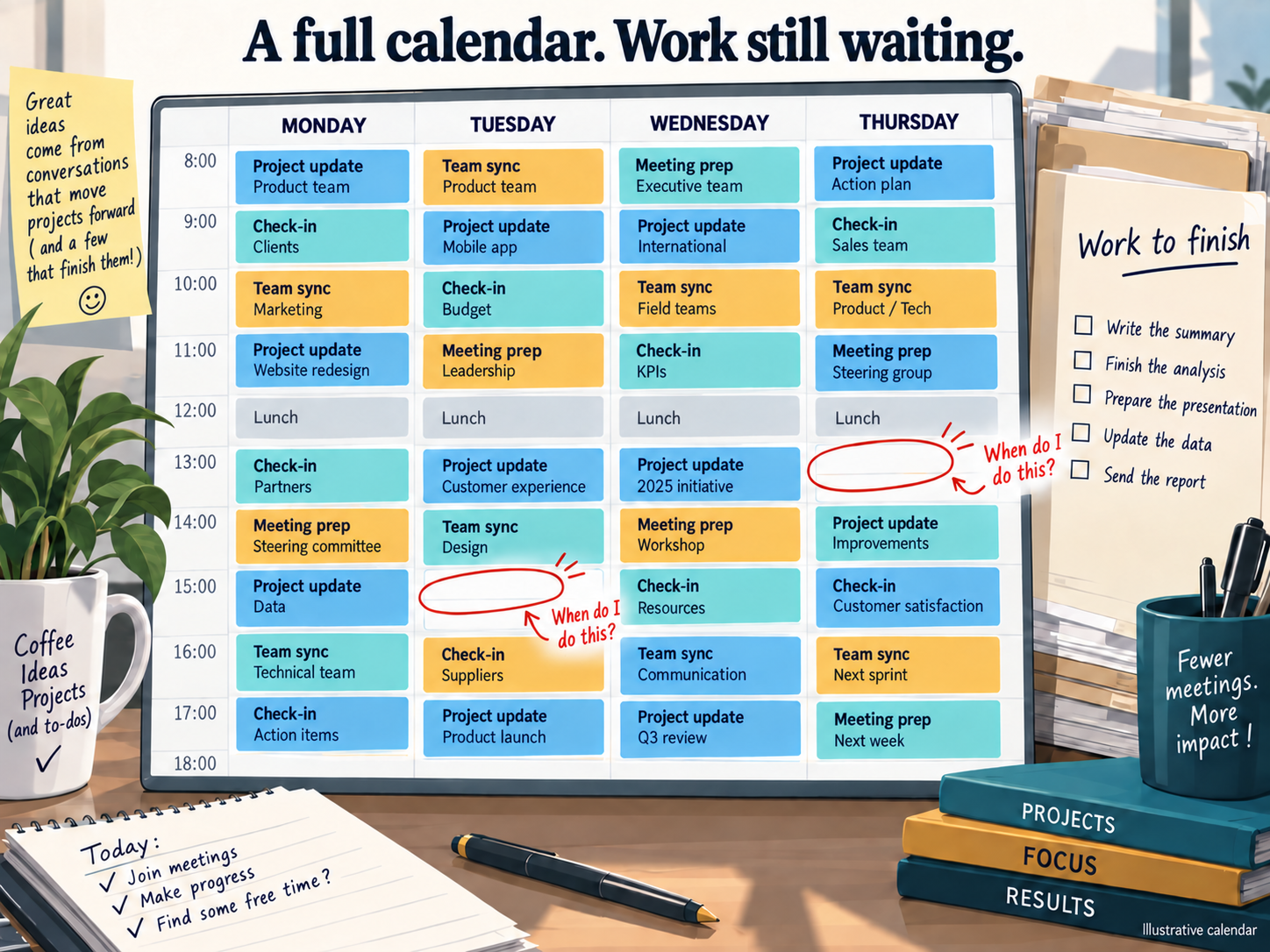
Imagine an ordinary Tuesday. A team catch-up, a project steering meeting, a meeting with another department. Between calls, you open the report due on Friday. You read a few lines. It is already time to join the next call.
By the end of the day, you have discussed plenty of work. Your report has barely moved forward.
This is an illustrative scenario. If it looks like your calendar, start with next week: which meetings could you attend differently, and which one could you change yourself?
The aim of your first experiment: free up a usable block of time and make progress on a specific piece of work.
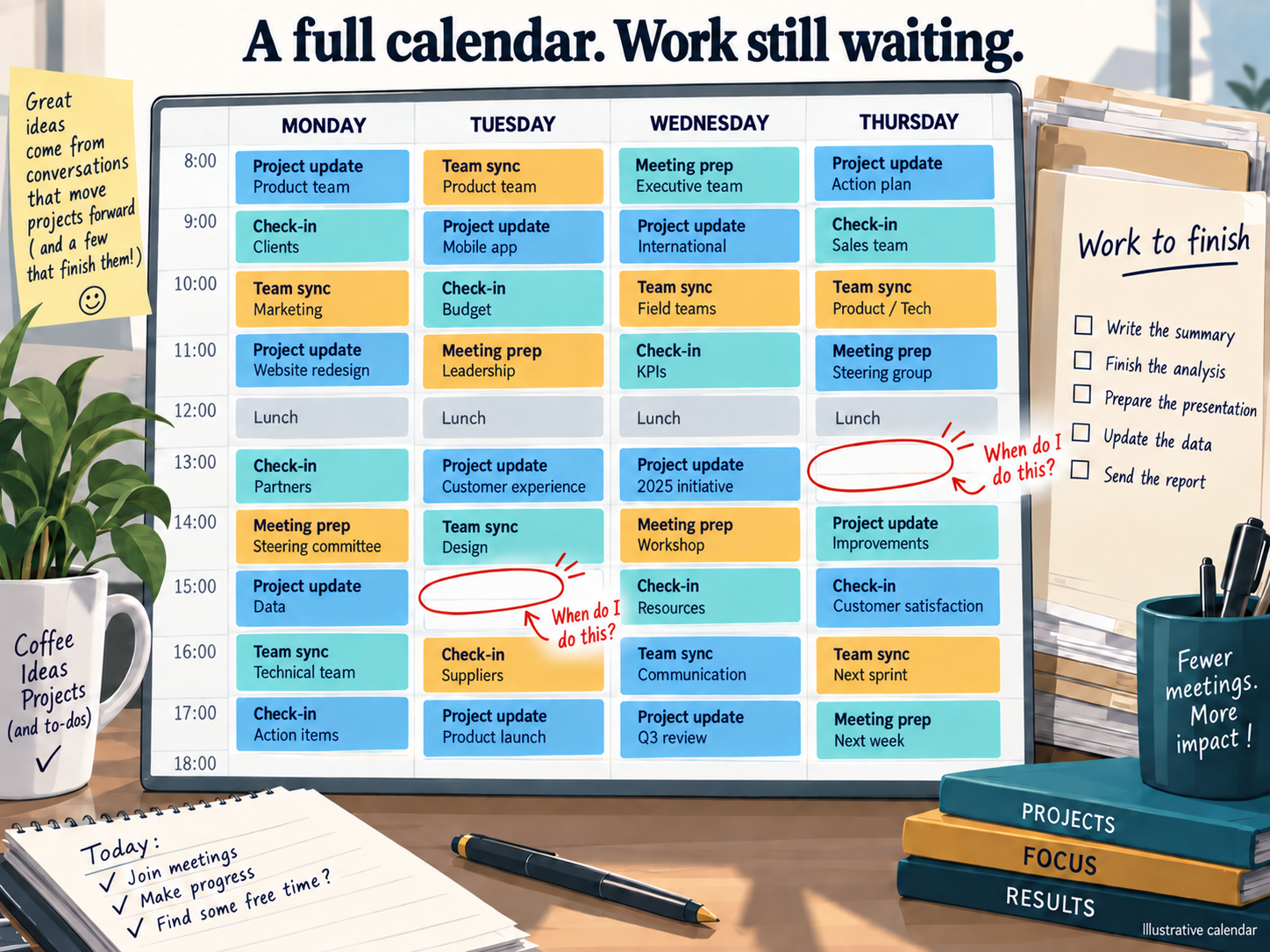
Open your calendar and identify your role
Take fifteen minutes. For each meeting next week, write down what is expected of you:
- I decide: a decision needs my approval.
- I contribute: I bring information or expertise needed for the discussion.
- I stay informed: I listen to understand the decisions and their implications.
A meeting may combine these roles. If so, identify the part where your presence is useful.
Start with an invitation you mainly accept to stay informed. Ask the organiser whether a decision summary would be enough. Some conversations also help you understand the context or maintain a relationship: consider what you would lose before stepping back.
“I need to make progress on report X before Friday. Will you need input or a decision from me during this meeting? If I am mainly attending to stay informed, could I read the decision summary instead?”
If only one item concerns you, suggest covering it first and leaving afterwards. Agree on this in advance: leaving a call without explanation can leave others unsure what to expect.
Change a meeting you organise
Choose a recurring meeting built around a round of status updates. For the next session, ask everyone to add three lines to the shared document you already use:
- What has moved forward.
- What is blocked.
- What decision or help is needed.
Explain that the meeting will focus on blockers and requests that need a conversation. Give participants time to read the document beforehand.
If nobody reads the update and everything is repeated aloud, you will have added another task. After the experiment, ask what was useful and what was missing.
For a meeting that has become purely informational, you could also suggest skipping the next two sessions. Specify where people should raise problems and when you will review the experiment. This lets you test its usefulness without immediately deciding to cancel it for good.
When attendance is required, ask your manager to set priorities
You do not control every invitation. A committee meeting requested by your manager calls for a different conversation from a meeting you organise yourself.
Make the conflict concrete: the meeting, the work expected of you and the deadline affected.
“With the committee meetings scheduled and the preparation they require, I will not be able to finish X by Friday. Would you prefer me to ask a colleague to attend one meeting on my behalf, reduce the scope of the report, or move its deadline?”
Offer options you can actually put into practice.
If a colleague represents you, give them a clear remit: what they can decide, what needs your approval and what they should report back. Check their availability too. Passing your overload on to them would not solve the problem.
Do three things tomorrow
Rethink your attendance at one meeting. Change one meeting you run. Then assign the time you free up to a specific outcome, such as completing the analysis for report X.
Reserve that time as soon as the change is agreed. An empty slot can easily fill up with another invitation.
The following week, check: did the work move forward? Was a decision delayed while people waited for your response? Did you simply replace the meeting with more messages?
Keep what works and adjust what causes problems for the team.
Before you close this article, choose the invitation you are going to respond to differently.